Connect TradingView alerts to MT5 and cTrader
This guide shows how to make a TradingView alert place a real order on your own MetaTrader 5 (MT5) or cTrader account. TradingView sends the alert to LOTUX over a webhook; LOTUX checks it against your secret, applies your risk rules, and forwards the order to your account. The same flow works on both platforms - MT5 through the LotuxBridge EA, cTrader through the LOTUX cBot.
How it works
A TradingView alert is a message your chart or strategy fires when a condition is met. Instead of just emailing you, the alert can call a webhook - a URL that receives the message and acts on it. LOTUX is that receiver: it authenticates the alert with your secret, applies the risk rules you set (lot size, max risk, allowed symbols), and executes on your connected account.
- You keep full control of the account - LOTUX only executes; it is not a broker.
- Works on MT5 (LotuxBridge EA) and cTrader (LOTUX cBot) - the account you connect decides the venue.
- Your risk rules are applied on every alert before an order is placed.
Step 1 - Connect your MT5 or cTrader account
Before an alert can trade, connect the account once. The flow is the same on both platforms; only the file differs.
Create a license
In LOTUX, create a license and give it a memorable name (e.g. "MT5 ICMarkets #1234"). You get a license key that looks like LTX-XXXXXXXX.
Download the bridge file
Download LotuxBridge.ex5 for MT5, or the LOTUX cBot (LOTUX.algo) for cTrader.
Install it
MT5: copy the file to MetaTrader 5 → MQL5/Experts/. cTrader: add the cBot via Documents → cAlgo → Sources → Robots/ (or cTrader → Automate → Add → from File).
Attach it to a chart
MT5: Navigator → Expert Advisors → drag LotuxBridge onto any chart. cTrader: Automate → cBots → drag the LOTUX cBot onto any chart.
Paste the license key
Paste your key and click OK (MT5) / Start (cTrader). The bridge connects to LOTUX automatically - your account shows online.
Step 2 - Point your TradingView alert at LOTUX
Enable TV Bridge
In LOTUX, open the TV Bridge app for your account and copy its webhook URL and secret.
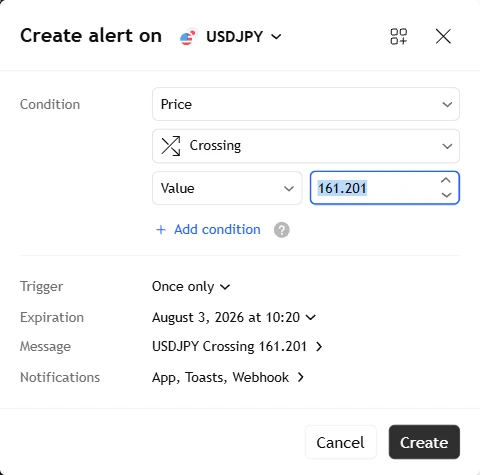
Create the alert
On your TradingView chart or strategy, create an alert and set the "Webhook URL" (Notifications tab) to the LOTUX URL.
Set the message
Paste the alert message template from your TV Bridge page (it carries your secret plus the action, e.g. buy / sell / close). The exact fields are in the TV Bridge docs.
Test it
Trigger the alert once. A connected, online account receives the order and you see it in your terminal and in LOTUX history.
The gotchas to know before you automate
A TradingView alert is only a webhook - an HTTP message. TradingView never talks to your broker by itself, so the real work is everything between "the alert fired" and "the order is live". These are the traps that break most do-it-yourself setups - LOTUX handles each one for you.
- Duplicate or late alerts: TradingView can re-fire on candle repaint. Without a check that drops repeats you double-enter - the #1 cause of "why did it open two positions?". LOTUX drops an alert it has already seen.
- Symbol naming differs by broker and venue: EURUSD on one broker is EURUSD.r or EUR/USD on another, and MT5 and cTrader name symbols differently. LOTUX maps the symbol per venue so the order is not rejected.
- Hedging vs netting: MT5 accounts can be hedging or netting, and cTrader behaves differently again, so "close" and "reverse" are not identical across them. LOTUX applies the right logic per account.
- Where it executes: LOTUX runs through the standard MT5 EA or cTrader cBot on your own account - not a proprietary server trading on your behalf. It is self-hosted, so your broker login never leaves your machine.
MT5 vs cTrader - what to expect
| MT5 (LotuxBridge EA) | cTrader (LOTUX cBot) | |
|---|---|---|
| Bridge file | LotuxBridge.ex5 | LOTUX cBot (LOTUX.algo) |
| Market orders (buy/sell/close) | Yes | Yes |
| Stop-loss / take-profit | Yes | Yes |
| Limit / stop pending orders | Yes | Yes |
For everyday TradingView alerts - enter, exit, set SL/TP, place a limit or stop order - both platforms behave the same. A few advanced External-Signals actions differ; see the webhook guide.
Run this on your own account
This is the exact flow LOTUX runs for every TradingView alert. Run the bridge on your own machine - it executes through your own EA/cBot.
Read the TV Bridge docs →Frequently asked questions
- Do I need a VPS to keep it running?
- The bridge runs wherever your MT5 or cTrader terminal runs - your own machine (self-host). That machine needs to stay on with a stable connection for automation to run; a VPS is just another machine that stays on, so it is optional. Your EA/cBot is what executes.
- Does this work on both MT5 and cTrader?
- Yes. Connect an MT5 account with the LotuxBridge EA, or a cTrader account with the LOTUX cBot. The account you connect decides the platform; the TradingView setup is the same.
- Will LOTUX place trades I did not approve?
- LOTUX only acts on alerts you send and rules you set. It applies your risk limits on every alert and executes on your own account. It is not a broker and does not give investment advice.
- Does TradingView place trades directly?
- No. A TradingView alert is only a webhook - an HTTP message. It never reaches your broker by itself; you need a bridge like LOTUX to receive it and place the order on your own account.
- Will duplicate alerts open duplicate trades?
- Not with LOTUX. TradingView can re-fire the same alert (for example on repaint); LOTUX checks whether it already saw that alert and drops the repeat, so you do not double-enter.
- Do I have to give anyone my broker password?
- Self-hosted, your broker login stays on your own machine and LOTUX never sees it. LOTUX executes through the standard EA/cBot on your own account, not by trading from a shared black-box server.